Flora and Fauna
Our estate lies within the Western Ghats, one of the world’s eight “hottest hotspots” for biological diversity and a UNESCO World Heritage site. Stretching along India’s western coast, this ancient mountain range shelters nearly a third of all plant, fish, reptile, bird, and mammal species found in India — many of them found nowhere else on Earth.
At Lemon Tree Plantations, we practise shade-grown agriculture in the Malnad tradition: coffee, pepper, and areca cultivated beneath a canopy of native and naturalised trees. This approach creates a layered, forest-like habitat that sustains a remarkable diversity of life. Our estate is not a monoculture; it is an agroforest — a working landscape where farming and ecology coexist.
Research by the Nature Conservation Foundation and the Indian Institute of Science has shown that shade coffee agroforests in the Western Ghats can harbour biodiversity levels comparable to natural forest fragments, particularly for birds, butterflies, and native trees. A recent study of polyculture shade coffee estates in Hassan and Chikmagalur districts identified ninety native tree species suitable for forest restoration, including thirty of high conservation priority.

Birds
The plantation is a sanctuary for the exotic birdlife of the Western Ghats, where the canopy vibrates with life. From the iconic Malabar Trogon to the resonant call of the Great Hornbill, our estate protects species that are vital to the ecosystem's health. These avian residents contribute to natural pest control and pollination, thriving in the harmonious environment we painstakingly maintain for future generations.
Birds spotted at Lemon Tree Plantations
The Canopy: Shade Trees and Forest Giants
The upper storey of the plantation is its defining feature — a tall, spreading canopy that provides shade for the coffee below and habitat for birds, epiphytes, and arboreal mammals above. Our canopy includes both indigenous species conserved from the original forest cover and trees planted or encouraged over generations of estate management.
Native Hardwoods
Indian Rosewood (Dalbergia latifolia) — A prized timber species now protected under law, rosewood trees on the estate are living remnants of the Malnad's original moist deciduous forest. Their broad crowns provide excellent shade, and their deep roots improve soil structure.
Teak (Tectona grandis) — Scattered across the higher blocks, teak trees mark the estate's boundary with drier habitats. Their large deciduous leaves create a seasonal light cycle that benefits the understorey.
Mathi (Terminalia tomentosa) — One of the signature trees of the Western Ghats moist deciduous forests, contributing to the canopy alongside rosewood and honne.
Honne (Pterocarpus marsupium) — The Indian Kino tree, valued in traditional medicine and as a shade species, with attractive reddish heartwood and a spreading crown.
Fruit and Utility Trees
Jackfruit (Artocarpus heterophyllus) — Ubiquitous in the Malnad, jackfruit trees serve triple duty: canopy shade, fruit production, and habitat. Their massive fruits attract civets, squirrels, and fruit bats, while their bark hosts epiphytic orchids and ferns.
Wild Mango and Jungle Mango — Several Mangifera species grow throughout the estate, their fleshy fruits sustaining hornbills, barbets, and other fruit-eating birds during the summer months.
Java Plum (Syzygium cumini) — Known locally as nerale, this evergreen tree produces small purple-black fruits that are a favourite of bulbuls and other passerines. Its dense foliage provides year-round shade.
Neem (Azadirachta indica) — Valued for its pest-repellent properties and medicinal uses, neem trees appear along estate roads and boundaries.
The Silver Oak Question
Silver Oak (Grevillea robusta) — This fast-growing Australian import is the most common shade tree in Karnataka's coffee belt, widely planted because it grows quickly, supports pepper vines well, and does not compete heavily with coffee for water. However, research shows that estates with a higher proportion of native shade trees support significantly richer bird communities. At Lemon Tree, we maintain silver oaks where they serve a structural purpose, but we are progressively enriching the canopy with native species.
Trees

Pollinators
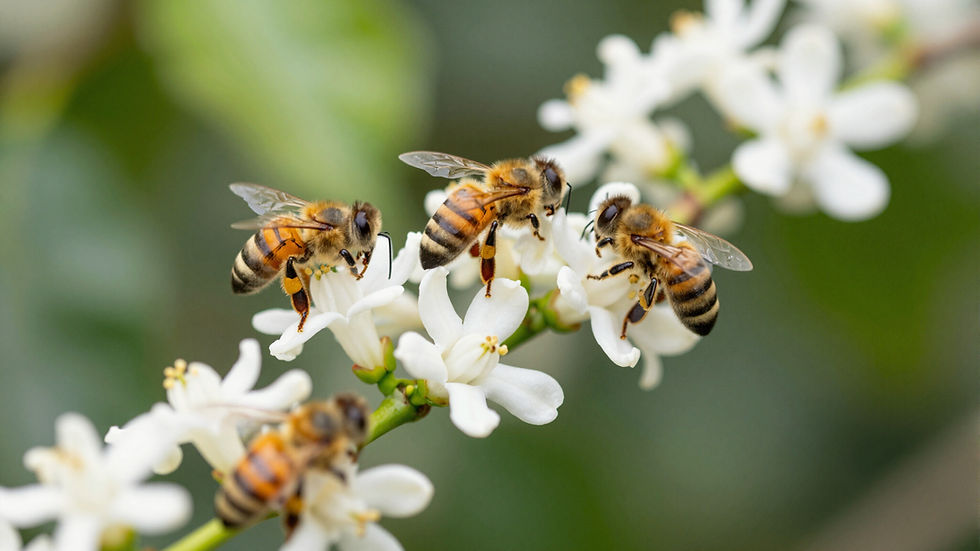
Honeybees and other local pollinators are the silent heartbeat of our plantation. They ensure the vitality of our coffee and pepper crops, darting between blossoms in a delicate dance that transforms flowers into the rich harvests we celebrate. By providing a chemically-free, diverse habitat, we support these essential creatures who, in turn, sustain the life of the Western Ghats.

Mammals
The lush undergrowth of our plantation provides a haven for the region's diverse mammals. From the shy Deer and Wild Goat grazing at dawn to the Boars that operate in the dark, our sustainable farming practices ensure a thriving habitat for these mountain residents.
The mammal that excites us most is a frequent visitor, day and night. The Indian Elephant has been kind to us, never destroying anything but the fence on the boundary.
We allow wildlife to move freely, and we totally forbid bunting.
